WORLD CITIZEN FIRST, NATIONAL CITIZEN SECOND
A New Foundation for Lasting Peace
A New Foundation for Lasting Peace
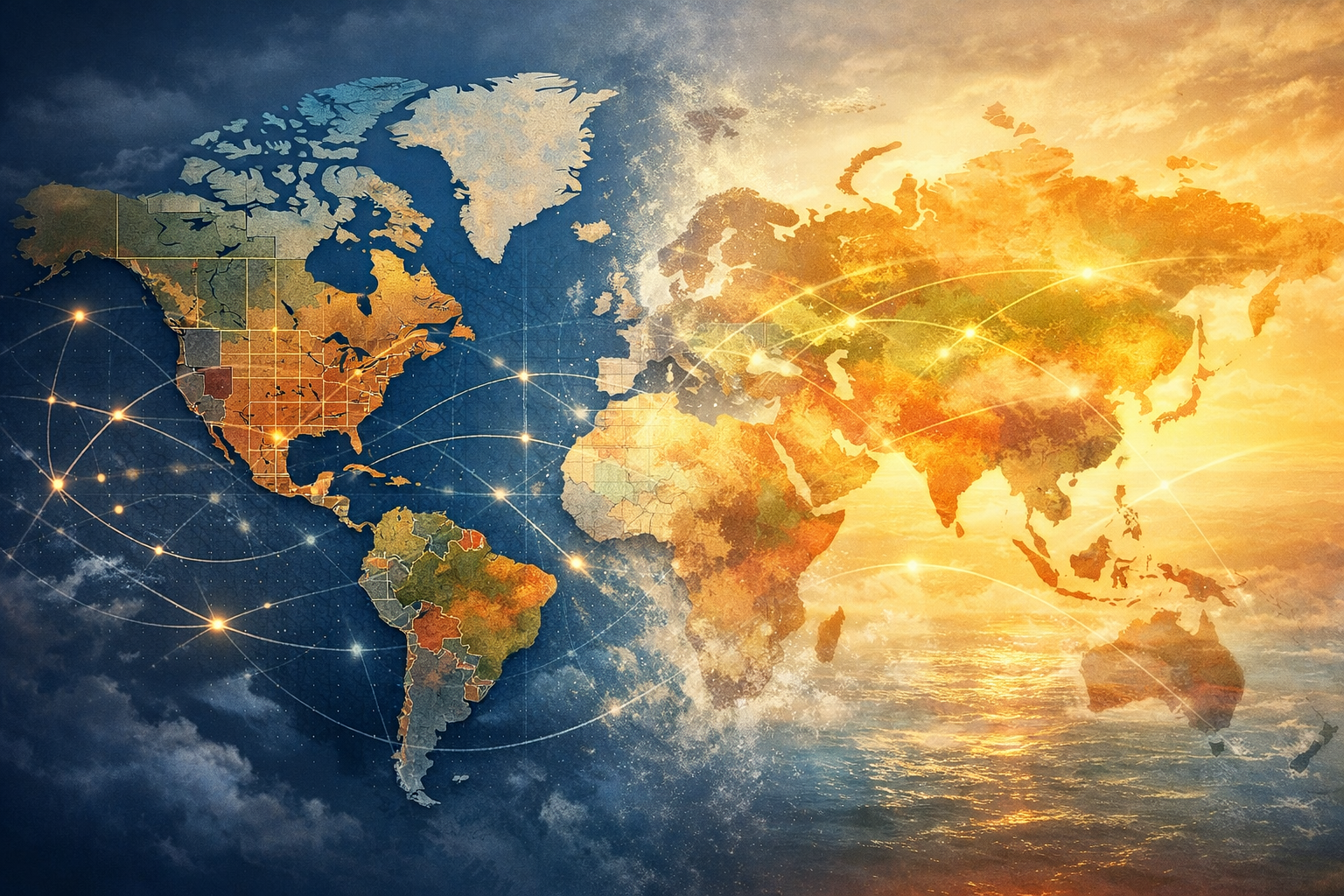
Borders are a human invention. They were drawn by kings, armies, treaties, and accidents of history — not by nature, not by reason, and certainly not by any universal principle of human dignity. Yet for centuries, those lines have been among the most powerful forces shaping human destiny. Wars are fought over them. Families are separated by them. People are told who they are, who they are not, and who they are permitted to care about — all because of which side of a line they were born on.
This is not destiny. It is a choice. And it is a choice we can unmake.
The proposition is simple: What if every human being on earth considered themselves a citizen of the world first — and a citizen of their nation second?
Not instead. Not in opposition. Second.
This idea is not new. Over two thousand years ago, the Greek philosopher Diogenes was asked where he came from. His answer was revolutionary for its time and remains radical today: “I am a citizen of the world.”
The Stoic philosophers who followed him built an entire moral framework around this concept — that all human beings share a common reason, a common dignity, and therefore a common citizenship that transcends every political boundary. The Roman emperor Marcus Aurelius, one of the most powerful men who ever lived, wrote in his private journal that his first duty was not to Rome but to the human race.
Immanuel Kant, writing in 1795, proposed a framework he called Perpetual Peace — a world governed not by the raw power of nations but by universal laws protecting every individual regardless of nationality. He saw world citizenship not as idealism but as the only logical endpoint of human moral development.
These were not dreamers. These were among the sharpest minds in human history. They saw something that power and tribalism have always worked hard to obscure: that our common humanity is more fundamental than any political identity we inherit at birth.
National identity is not inherently dangerous. Pride in one's culture, language, history, and community is a natural and beautiful part of human experience. The problem arises when national identity is not just a source of pride but a hierarchy of worth — when it becomes the framework through which we decide whose children matter, whose suffering counts, and whose future deserves protection.
When nationality is primary, the logic runs like this: My people first. Your people only if it benefits mine. This logic has justified slavery, colonialism, genocide, and every major war in recorded history. It is not a bug in the national identity system. It is a feature — one that has been deliberately cultivated by those who benefit from division.
The nation-state, as a political unit, has produced extraordinary achievements. It has also produced extraordinary violence. The question is not whether nations should exist. The question is whether national identity should be the outermost ring of our moral concern — the boundary beyond which we feel little obligation.
The evidence of two thousand years suggests the answer is no.
World citizenship is not a political position. It is a moral orientation — a decision about where you place your deepest loyalty.
Recognizing shared humanity before recognizing difference. When you see a person, you see a human being first — before you see their passport, their religion, their skin color, or their politics.
Holding your government accountable to universal standards. A world citizen does not say “my country, right or wrong.” They say “my country should be right — and when it is wrong, I will say so.”
Taking responsibility for shared problems. Climate change, pandemics, poverty, nuclear weapons — these do not stop at borders.
Valuing cultural diversity as a collective treasure. World citizenship does not mean a grey, homogenized global monoculture. Quite the opposite.
Wars require enemies. Enemies require the belief that the people on the other side are fundamentally different from us — less human, less deserving, less real.
When a soldier sees a fellow human being instead of an enemy, the machinery of war begins to break down.
World citizenship does not eliminate conflict. But it changes the framework from “How do we defeat them?” to “How do we solve this together?”
The most common objection is that world citizenship is naive — that humans are tribal by nature.
We are tribal by instinct. But we are not slaves to instinct. Every moral advance in history required overcoming one.
The tribal instinct is real. So is our capacity to transcend it.
This proposal does not require abandoning love of country. It requires only a reordering of priority.
Nation first, world second — this is the old model.
World first, nation second — this is the new model.
Change of this magnitude happens through culture — through the stories we tell, the values we teach, the language we use.
It happens when a parent tells a child: “You are from this place, and this place is good. And so is every other place, and so is every person in it.”
It happens when a leader says: “Our national interest includes a peaceful and prosperous world.”
It happens when an ordinary person looks at suffering far away and feels solidarity instead of distance.
The border that most needs to be dissolved is the one inside the human mind — the one that divides “us” from “them.”
— Terra Nova Initiative