
ABUNDANCE vs. SCARCITY
The World We Live In vs. The World We Think We Live In
The World We Live In vs. The World We Think We Live In
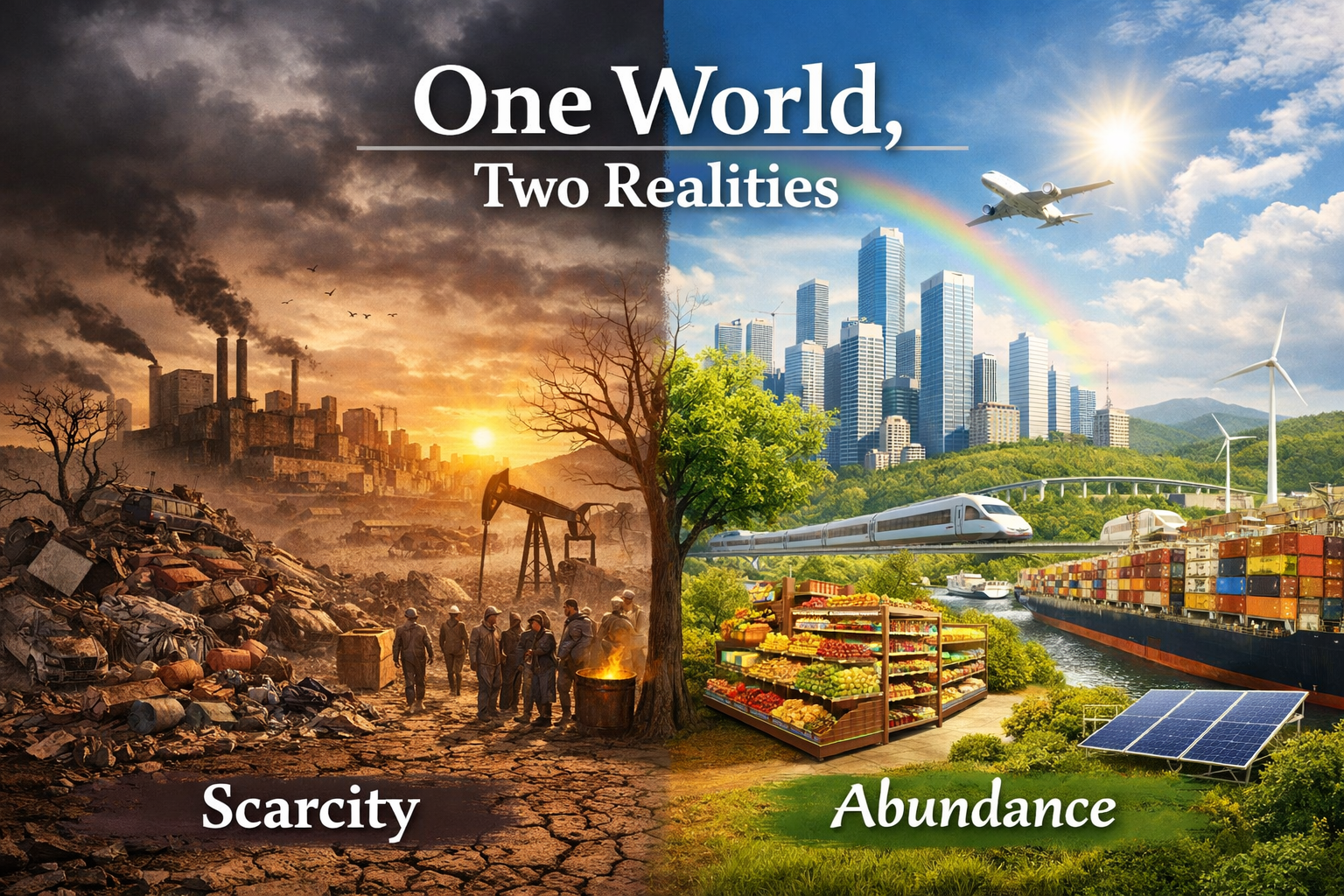
Walk into a Walmart and you’ll see it immediately: 140,000 separate items, millions of units on the shelves, trucks arriving every hour, and a supply chain that never sleeps. Food, clothing, electronics, tools, medicine, toys, furniture — an entire microcivilization under one roof.
That is abundance. Not theoretical abundance. Not future abundance. Abundance that already exists.
And yet, step outside that same store and you’ll hear people talk about the world as if it’s fragile, limited, and on the brink of running out. They speak in the language of scarcity — as if we’re still living in 1820, not 2026.
This contradiction is the heart of the modern human dilemma.
Scarcity thinking is a relic from a world that no longer exists:
Scarcity was once real. Today, it’s mostly psychological.
We live in a world where:
People already know abundance is real. When you say it in conversation, they nod. They’ve seen the shelves. They’ve seen the warehouses. They’ve seen the endless choices.
What they haven’t seen is the implication:
If abundance is real, then the systems built on scarcity no longer make sense.
People know abundance exists. They just don’t realize it means we don’t have to live the old way anymore.
Scarcity is not a natural law anymore — it’s a business model.
Paywalls, subscriptions, fees, licenses, tolls, interest, penalties, “premium tiers,” artificial limits — these are not reflections of reality. They are mechanisms of control built on the assumption that people must be kept in a state of “not enough.”
Scarcity is profitable. Abundance is liberating.
Humans are naturally generous. We share food, ideas, stories, music, knowledge. We help strangers. We volunteer. We create for free. We teach for free. We build communities for free.
But when people are forced into scarcity thinking — when they fear losing what little they have — generosity collapses.
We don’t need to invent abundance. We already have it.
The shift is simple:
We live in a world of abundance strangled by artificial scarcity.
The shelves prove it. The warehouses prove it. The supply chains prove it. The technology proves it. The productivity numbers prove it.
Abundance is not the future. Abundance is the present. Scarcity is the past.
The question is whether we’re willing to let the past go.