
A New Constitution as the 28th Amendment
A Terra Nova Philosophy Essay
A Terra Nova Philosophy Essay
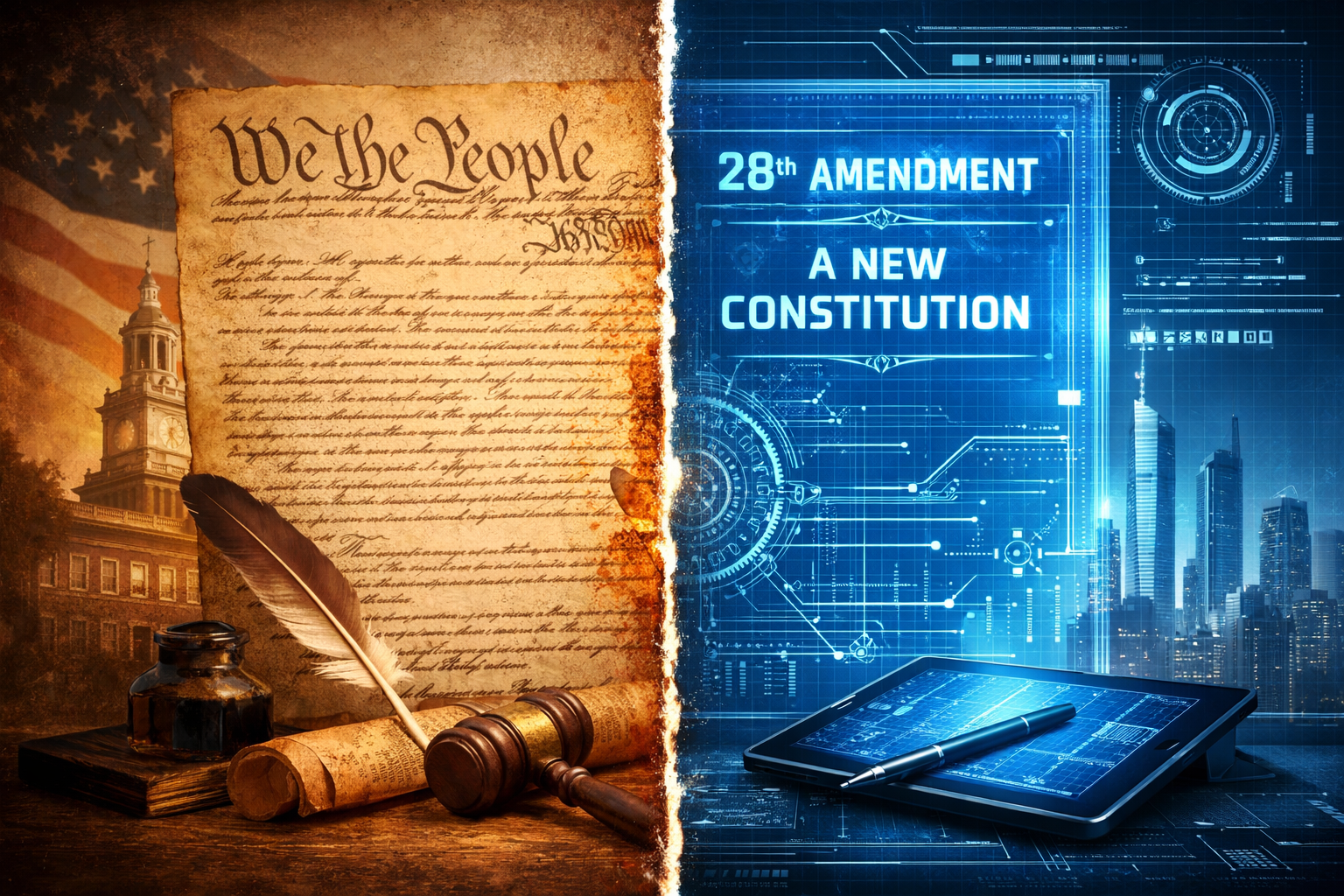
The United States Constitution has been amended twenty‑seven times, but never replaced. For more than two centuries, the document has served as both a foundation and a constraint — a source of stability, but also a barrier to needed modernization. The world of 2026 bears almost no resemblance to the world of 1787, yet the operating system of the nation remains largely unchanged. The question is no longer whether the Constitution should evolve, but how.
One of the most overlooked truths in American civics is that the Constitution can be replaced through the amendment process itself. Nothing in Article V prohibits an amendment from being comprehensive, structural, or transformative. The Constitution does not limit the scope of an amendment — only the process by which amendments are adopted. This means that a fully rewritten Constitution, if properly ratified, can legally enter the system as the 28th Amendment.
This is not a loophole. It is a design feature.
Americans are deeply attached to constitutional continuity. Even those who believe the system is broken often fear the instability of starting from scratch. The amendment process provides a bridge — a way to modernize without discarding the nation’s legal lineage.
A new convention would be unpredictable, unstructured, and potentially destabilizing. Submitting a complete constitutional rewrite as an amendment bypasses this uncertainty and uses a process the nation already understands.
A new Constitution submitted as the 28th Amendment would be written in full, internally consistent, publicly available, debated openly, and ratified or rejected as a whole.
The first reaction many people have to the idea of a new Constitution is a kind of civic muscle memory — a reflexive belief that the old way is good enough. But this confidence is based more on tradition than on inspection. When we look closely at the modern American system, we find not timeless perfection but a patchwork of loopholes, contradictions, and structural vulnerabilities the Founders could never have anticipated.
One of the most glaring examples is the legal doctrine that treats corporations as persons for certain constitutional purposes. This interpretation, built through judicial decisions rather than democratic debate, has allowed artificial entities with vast financial resources to claim rights intended for human beings. The result is a distortion of political influence so severe that a single corporation can exert more pressure on lawmakers than millions of citizens combined.
Closely related is the problem of lobbying. In theory, lobbying is a mechanism for petitioning the government — a right guaranteed to every citizen. In practice, it has become a parallel political system in which access is determined not by civic participation but by financial capacity. A single well‑funded lobbyist can shape legislation more effectively than thousands of ordinary voters acting together.
Another reason the “old way is fine” argument collapses is that much of American society does not run on the literal text of the Constitution at all. It runs on something far more fragile: judicial precedent.
Over two centuries, courts have built an enormous lattice of interpretations, doctrines, and exceptions that now function as the real operating system of the United States. These precedents often carry more weight than the Constitution’s actual words — and once established, they are extraordinarily difficult to overturn.
A new Constitution allows the nation to clarify ambiguous areas of law, eliminate outdated doctrines, explicitly define rights that currently exist only through interpretation, and reduce reliance on precedent as a substitute for democratic decision‑making.
The current system has become so complex, so burdened with accumulated legal debris, that meaningful reform is nearly impossible. We have built a society where lawyers are not just helpful — they are required for ordinary life. Not because people are incapable, but because the system has grown into a maze of technicalities, exceptions, precedents, and procedural traps.
Laws are supposed to be clear, accessible, and understandable. Instead, they have become so convoluted that even experts disagree on their meaning. Entire industries exist solely to interpret the ambiguities created by previous interpretations.
Over time, authority in the United States has expanded through legislation, bureaucracy, surveillance, and precedent — often without explicit democratic consent. Personal liberty has gradually been eroded not by a single act of tyranny, but by the slow accumulation of institutional power.
A modern Constitution must reverse this trend by explicitly protecting digital privacy, personal data ownership, limits on algorithmic governance, transparency requirements, and strict boundaries on surveillance. At the same time, it must weaken the mechanisms of authority overreach by reducing concentrated power, limiting emergency authority, enforcing transparency, and ensuring democratic oversight.
A new Constitution submitted as the 28th Amendment is not a radical act. It is a responsible one. It acknowledges that the old framework, while brilliant for its time, contains vulnerabilities that have been exploited in ways the Founders could not have imagined.
It is not rebellion. It is renewal. It is the next chapter of the American story.