Revolutionary change in Africa and
developing country plans:
Ubuntu speech!
Kaslue Isaac - God’s Grace children
Winnie babirye - NOgreener
gardens Africa
Ujam Daniel Lino Wonders - world leader, African leader
Mumbere Johnny rap - JohnnyG_official -
Help Students in Africa Project
Keith Spence - botanically correct,
hydroponics farms for Africa
Mpamu Kenzi Gideon - Gideon’s Street
Kids
Eugene John - PermacultureDesign
- close to Kampala, Uganda
Andre letula
lefils -
3000 for water perfection device -
vortex energizing device by president
5000 dollars to run clean water for Kaslue
*START INITIATIVE TO SAVE ALL SEEDS!!!!*
We must set up
proper orphanage, adoption, and family resource programs, including:
Family Services
Orphans don't just need stuff.
Orphans need good families. We must expedite and perfect adoption, making the
process more organized, simplified, and cheap. Organize single African orphanage
system. Foster care programs must become more normalized, taking burden off of
orphanages. We must perfect the follow up system for both adoption and foster
care, which regularly checks on children throughout life, maybe biannually, at
least, likely more. We will set up familial support with mental healthcare, job
provisions, food and other basic provisions, etc.. Family scholarship program to teach skills,
etc. We must do everything in our power to help families reunite and live
sustainable lives.
The Basics
Orphanages are always in need of the
basic supplies, such as diapers, underwear, socks, shoes, pajamas and other
clothing. Some items that may be taken for granted may seem like a luxury to
children in orphanages, such as bedding, toys, televisions, radios, books,
electronics, as well as play and sports equipment. Medical supplies are TOO
necessary and helpful, including toothpaste, toothbrush, soap, first aid kits,
IV tubing and saline solution, gauze, vitamins, cortizone
creams and antibiotic ointment, not to mention more natural medicines that can
easily be donated.
School Necessities and teachers
Most organizations cannot afford to
educate their youth, so they may need school supplies to help children finish
their education. Donate items such as binders, paper, pens, pencil sets and
backpacks, notebooks, rulers, art supplies, markers, calculators and paper.
Household Needs
An orphanage must function as a large
home for children without other guardians, so they must have all the basic
essentials of a home. Potential donations include surge protectors, extension
cords and light bulbs. Cleaning supplies are gratefully accepted, as are
antibacterial soap and hand sanitizer. Beds, blankets, sheets and pillows are
also useful donations.
Land and Sustainability
Land donated to orphanages is put to
good use. Sending a fruit tree to an orphanage creates a sustainable and
renewable resource. Farmers who have older equipment may prefer to donate this
equipment so the orphanage can tend to the donated land. Other donations
include chickens, cattle, feed and seeds that provide renewable sources of
food.
Donations for Services
Many children have to go without the
basic medical services they need in orphanages or other types of group homes. A
donation for these services can have a tremendous impact on a child's health.
Donate a certificate for free medical services to the orphanage. Prepay the
costs for children to receive dental services, and
contact dentists to find some who are willing to provide volunteer services to
children at the orphanage. Organize a “Service Auction for Orphans,” asking
family members and friends to donate a service to be auctioned off with
proceeds going to help orphans. Ask your church to sponsor an orphan or project. Contact your dentist, doctor, orthodontist,
chiropractor or anyone you regularly pay for services, and ask if they will
donate a portion of your payments to help an orphan.Organize
a “Dollars for Orphans” drive. Set a week where you ask everyone you come in
contact with for $1 to help an orphan. Explain that most orphans live on less
than $1 each day.
Unify with and perfect other programs
All orphanages must unify efforts
with each other and programs from other countries, which already come to help
orphans in other areas, countries, etc.
Establish the
people’s International Revolutionary Party:
https://aaprp-intl.org - convince these to end divisions and unite with real party
under new goals.
Implement Democratic Republic of
deserving and enlightened leaders of Africa. Round table style council of
equals will make up government for unified Africa.
Water
supplies/Green and grey infrastructure:
All people have the right to clean
water and proper infrastructure.
SAFE ACCESS TO WATER AND SANITATION
We will work hard to provide and
facilitate safe access to water and sanitation for all of its residents in
terms of well- defined minimum standards. In particular, we must work with
communities in informal settlements and with other stakeholders to improve the
daily experience of access to water and sanitation, with an emphasis on
building trust and increasing safety within these communities through this
process.
WISE USE
We will promote the wise use of water
by all water users. This will include promoting water conservation behaviour through (a) pricing water with reference to the
cost of providing additional supply, while retaining the commitment to provide
a basic amount of water for free for those not able to afford this; (b)
revising by-laws and planning requirements, and using other incentives to
support water efficiency and the treatment and reuse of water; (c) supporting all
people’s right’s by substantially improving customer management and engagement;
and (d) managing the water network effectively to reduce losses and non-revenue
water.
SUFFICIENT, RELIABLE WATER FROM
DIVERSE SOURCES
We will develop new, diverse supplies
of water including groundwater, water reuse and desalinated water, cost
effectively and timeously to increase resilience3 and substantially reduce the
likelihood of severe water restrictions in future. The City is committed to
increasing supply by building affordable new capacity of approximately 300
million litres per day
over the next ten years, and in
suitable increments thereafter, in a way that is adaptable and robust to
changes in circumstances.
SHARED BENEFITS FROM REGIONAL WATER
RESOURCES
We will work with key stakeholders
and partners, including other urban and agriculture water users and other
spheres of government, to make the most of the opportunities to optimise the economic, social and ecological benefits of
regional4 water resources, and to reduce the risks. This will be done through
collaborative processes.
WATER-SENSITIVE CITIES
We will actively facilitate the
transition of Cape Town over time into
a water-sensitive city with diverse
water resources, diversified infrastructure
and one that makes optimal use of
stormwater and urban waterways for the purposes of flood control, aquifer
recharge, water reuse and recreation, and is based on sound ecological
principles. This will be done through new incentives and regulatory mechanisms
as well as through the way the City invests in new infrastructure.
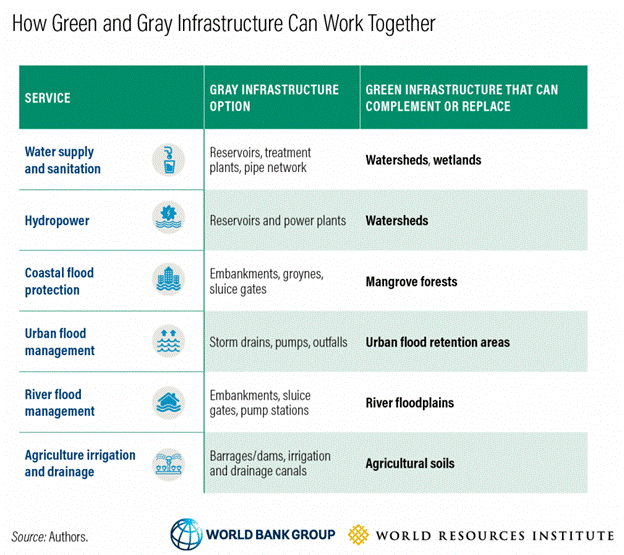
● Urban areas are benefitting from natural infrastructure or
“green” infrastructure, a strategically planned and managed system of natural
lands, working landscapes and other natural soil and vegetation systems across
a watershed or within a city, that perform many of same functions as built or
“gray” infrastructure. These essential functions, often carried out by the deep
roots and multi-layered tree canopies of healthy forests, include purifying
water, minimizing sedimentation, regulating flow and stormwater runoff, and
reducing the impact of floods and droughts.
● Natural infrastructure helps to provide high-quality source
water and well-regulated flow, which can not only lead to several potential areas of cost savings—such as avoided capital costs, lowered maintenance costs,
and reduced treatment costs—but also generate social and environmental
benefits. Furthermore, integrating natural infrastructure with engineered
solutions can protect and restore ecosystem services, enhance resilience to
climate change, bolster local economies, and help cities save money. Benefits
added from natural infrastructure are estimated at around $29 trillion per year globally. Cities should be planned to meet water needs,
using approaches that extend beyond the city limits and consider systems change
throughout entire city-regions.
● Water supply may be managed by the Local water utility,
source water management may sit within national agencies, while management of
water assets may sit with the international environmental authorities. Greater
integration and coordination across agencies is essential, and city leaders can
harness new ways of working, bringing coordinated action vertically and
horizontally, building local partnerships within cities and fostering
integrated solutions across the entirety of watershed regions.Planning
within the regional context can generate immense cost savings. It requires
working with regional land authorities and ensuring that land-use plans are
enforced to prevent indiscriminate development.
● Urban planning and management experts need to be informed of
the risks to the natural water cycle and flow regimes, placing the right
incentives and regulations to manage city expansion. Cities contain extensive
built-up infrastructure and impermeable surfaces, such as buildings and roads,
leaving flood waters with nowhere to go but into the streets. This can then mix with raw sewage or
flood pit latrines, creating the perfect setup for dangerous disease outbreaks
such as cholera.
● There are multiple benefits to redirecting expansion so that
it avoids green spaces and other areas important for flood control.
Ecologically-sensitive land use planning and management will support the health
of surrounding bodies of water, key areas for buffering storms, support
peri-urban agriculture and provide regional food security.
● We will circulate all water supplies, utilizing clean energy
as planned for world. Drainage systems will bring all water to water
distribution focal point where it’s cleaned with healthiest means(Steve’s
invention?), and redistributed as in other countries.
Homes will be designed to catch and utilize rain water.
● The project is a collaborative effort among city regulators,
property owners, and engineers. Sponge city projects in Xiamen and Wuhan have
performed effectively during heavy rainfall.
● Set Up Rain Catchment Tanks for every structure
● In areas that receive adequate rainwater, a rain catchment
system can be an economical solution to water scarcity. Also referred to as
“rain harvesting,” these systems work by connecting downspouts (pipes for
carrying rainwater from a rain gutter) to a water tank that is capable of
holding up to 100,000 liters of water. Rain catchment tanks are cost-effective,
easy to use, and are often used as primary sources of water in water-stressed
areas. By collecting rainfall in rain catchment areas throughout the year, communities
are able to maintain access to water during drier seasons of the year.
● Protect Natural Springs
● Natural spring water has been used for centuries as a form of
water supply. However, if a spring is not properly protected, it risks being
contaminated which makes the water unsafe to drink. Spring water supply systems
are typically constructed by building a spring box or spring house around the
spring to keep out animals, leaves, and debris. The water from the spring can
then be piped to a holding tank or hand dipped. Unfortunately, springs are open
to groundwater run-off which makes them easily contaminated. Furthermore,
because the water source may also be easily tampered with, a protective owner
must ensure that it is covered around the clock to keep the water safe and
clean.
● Install Sand Dams
● Sand dams are a low-maintenance and low-cost solution to
getting clean water in Africa. A sand dam is essentially a reinforced cement
wall that is built across a sand river. The dam helps retain rainwater by
capturing the soil laden water behind it, as the sand dam blocks run o water in the riverbed and stores clean water in the soil.
This makes for a semi-reliable option for water conservation in dry
environments. A mature sand dam can store millions of liters of water –
refilling after each rainfall providing a year-round supply of clean water to
hundreds of people. In addition to providing a reliable water source to
communities living in rural, remote areas, sand dams can also provide enough
water for tree planting and vegetable nurseries.
● Rehabilitate Old Wells
● Many communities in South Africa are able to receive clean
water through the rehabilitation of old wells. Fixing old wells can help
address water, hygiene, and sanitation issues that are often linked to illness
and disease. There are many ways to repair a well, such as building a wall
around the top with a reinforced concrete drainage apron that prevents surface
water from running into the well, in addition to utilizing sand dams (see
above). Unfortunately, old wells must be consistently cleaned to stay free of
disinfection by scrubbing down the sides with a chlorine solution to kill
microbes. This makes them an efficient, yet hard to maintain option for clean
water in Africa.
● Build New Wells
● One of the most effective ways to get clean water in Africa
is through the building of new wells. While one of the simplest methods
involves hand digging wells, this is a risky option due to the dangers involved
in construction. Also, if left uncovered, these wells can also easily become
contaminated, leading to water-borne illness. The building of “shallow wells”
(lower in depth), in contrast, can provide clean water at a low cost, and are
safer to build. Shallow wells can be built using a simple “small-rig” machine
that has the power to dig up to 150 to 200 feet. They are also portable and can
be moved from community to community. On average, the cost to build a well in
Africa is about $8,000 USD. For this amount, a hole can be drilled and a pump
installed that allows the community to access safe, clean drinking water. In
addition, the village is provided with sanitation and hygiene training to
minimize the risk of contamination. Each well is able to serve about 2,000
people and will generally last up to 20 years if properly maintained. To
maintain the well and address repairs, a small group of leaders are selected
from a village and trained to care for and maintain the well.
● Reforestation and sustainable agriculture projects upstream
of water treatment
● Ponds with liners and shade, drain piping all leading to pond
next to well add many fish, circulation, plants, Rivers run into lakes, lastly
establish hydroponics systems on all lakes
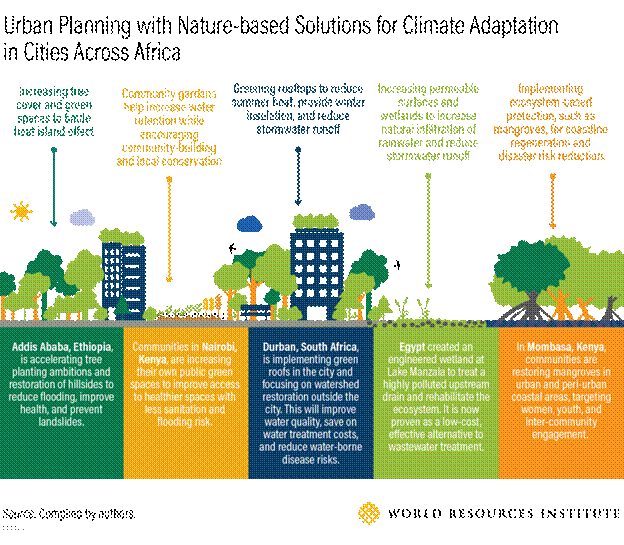
● In low areas, reduce stormwater flooding and reuse rainwater
by covering 80 percent of urban areas in materials that can capture water, such
as green roofs and permeable pavements. Create proper drainage, everywhere.
● Water supply and management must adapt to constrained
resources.
● Account for ALL resources in a community, in order to
Implement new economy
● Put end to price gouging, fix monetary value, set pricing.
● Modify refined educational syllabus to account for
infrastructure reformation and resource extraction/production.
● Expel other countries and all private companies from mining
Africa, offer opportunity to partner with the people to properly mine resources
as needed FOR AFRICA (or whichever country involved).
● Establish international trade relations. Organize and
Allocate resources fully and perfectly.
● Restructure all communities, housing, businesses, etc. to
perfect infrastructure by offering the families involved perfected and equal -
better amenities with everything needed in fair trade act.
Destroy malaria and other diseases,
etc. spread through mosquitoes by Creating proper drainage and destruction of
mosquito breeding sites, by filling all holes creating stagnant water.. and
spraying/spreading in all human populations and homes - mint, lavender, coffee
grounds in stagnant water?, camphor, garlic, tea tree and oil, basil and oil
and all other repelling plants, burning pinion/cedar wood. Scatter dry
granulated garlic in problem areas. Some of the worst areas are around trash
cans and in the tall grass borders that are always moist. Broadcast at 2 lbs per 1000 sq. ft. in beds, turf, pots and plants. Dry
granulated garlic can repel mosquitoes for up to four weeks. Garlic spray,
garlic pepper tea, aloe vera, citronella, vanilla, eucalyptus, tea tree oil and
citrus oil. Consider bti bactimos
briquettes or mosquito dunk.
The best nations to grow in africa - Ethiopia, Ghana, South Sudan, Morocco and DR CongoGrow incredible amounts of hemp, build many processing
machines, create biggest hemp industry in world. Clean all forests and perfect
them with permaculture, create great organic non GMO farms everywhere by
redistribution of lands with excellent housing. Hydroponic farms will solve the
hunger crisis.
Main crops grown in Africa:
● Maize
● Yams/sweet potatoes/potatoes
● Wheat
● Rice
● Sugar cane
● Cassava
● Sorghum
● Plantains
● Tomatoes
● Bananas
● Sugar beet
● Onion
● Millet
● Oranges
● Groundnuts with shell
Create proper African military by the
people and implement plans for the world.